Cost Models & Formulas
Calculating worker --concurrency and Replica Counts for High Throughput
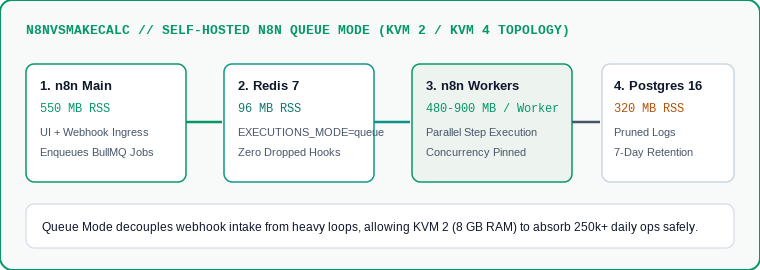
Use Little’s Law to size n8n worker replicas and concurrency flags for API-bound webhooks versus CPU-bound data transforms.
2 Replicas x 10 Concurrency = 12,000+ Webhook Runs/Hr
Throughput Equation for I/O-Bound Webhooks
If an average 10-step webhook spends 1.8 seconds waiting on external REST APIs, a single worker with --concurrency=10 processes ~5.5 workflows/second (19,800 runs/hour) with minimal CPU load.
Why Lower Concurrency Protects CPU-Bound OCR
For headless Puppeteer or PDF OCR tasks that pin CPU cores for 4 seconds each, drop worker concurrency to 2–4 across 2–3 replicas on KVM 4 so event loops stay responsive.
36-Month Cost & Capacity Breakdown
| Workload Type | Avg Run Latency | Replicas x Concurrency | Sustained Hourly Cap |
|---|---|---|---|
| JSON / Webhook I/O | 1.8s | 2 x 10 (KVM 2) | ~39,600 runs/hr |
| Heavy Array Transform | 3.0s | 2 x 6 (KVM 2) | ~14,400 runs/hr |
| Headless Puppeteer/OCR | 4.5s | 3 x 2 (KVM 4) | ~4,800 runs/hr |