Cost Models & Formulas
Budgeting Chromium & Tesseract OCR Memory Spikes on KVM 4
Prevent Linux OOM-killer crashes during concurrent headless scraping and invoice OCR workflows by capping Chromium tab concurrency.
650-950 MB per Tab | Safe Cap: 4 Concurrent Tabs on KVM 4
Why Browser Automation Breaks Default 4 GB Servers
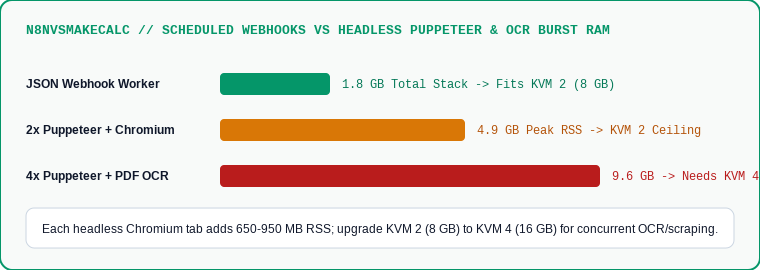
Launching headless Chromium inside an n8n Execute Command or community Puppeteer node allocates 650–950 MB per concurrent tab plus /dev/shm framebuffers. Four simultaneous webhooks easily exhaust 4 GB hosts.
Matching Concurrency Flags to KVM 4 (16 GB)
Setting --concurrency=4 on KVM 4 workers caps peak browser + Tesseract OCR memory near 9.6 GB, leaving ample headroom for Redis, Postgres 16, and burst swap protection.
36-Month Cost & Capacity Breakdown
| Concurrent Browser/OCR Jobs | Estimated Peak RSS | Recommended Host | Worker Command Flag |
|---|---|---|---|
| 1 Tab Sequential | 2.4 GB RSS | KVM 2 (8 GB) | worker --concurrency=1 |
| 2 Tabs Parallel | 4.9 GB RSS | KVM 2 (8 GB) | worker --concurrency=2 |
| 4 Tabs Burst | 9.6 GB RSS | KVM 4 (16 GB) | worker --concurrency=4 |